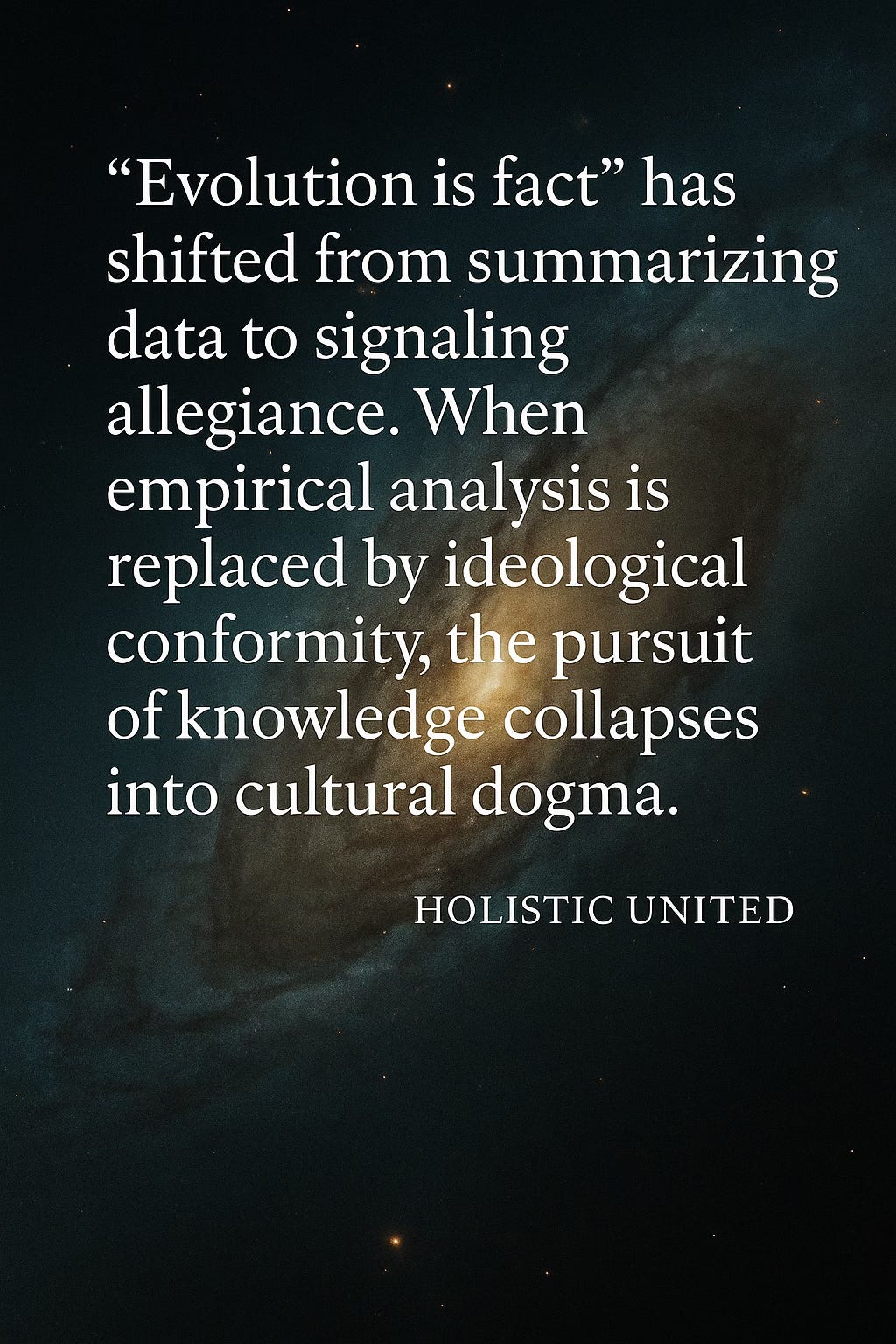
The modern debate around evolution no longer revolves on the level of empirical evidence but around the authority of belief. Within scientific institutions, evolutionary theory remains the unifying framework for biology, describing the mechanisms of variation, heredity, and selection that shape life. Yet in public discourse the statement “evolution is fact” often functions less as a summary of data and more as a declaration of allegiance. This article examines how a descriptive model can harden into a metaphysical creed, and why that transformation matters for intellectual integrity.
From the standpoint of David R. Hawkins’ Map of Consciousness, authentic science calibrates at the level of Reason, curious, self-correcting, and open to revision. Once a framework is used to police dissent or define moral superiority, it descends toward Pride, where certainty replaces inquiry. Historically, the power of science has come from its willingness to falsify its own assumptions. When advocates insist that a theory is beyond question, they invert the very principle that makes science trustworthy.
Discernment distinguishes method from metaphysics. Evolution as method investigates how species change; evolution as metaphysics claims to explain why consciousness, purpose, or morality exist. The first is empirical; the second is philosophical speculation dressed in scientific vocabulary. This category error, confusing mechanism with meaning, creates what philosophers call scientism, the belief that all truths are reducible to physical description. In doing so, it inadvertently repeats the very absolutism once attributed to religion.
The purpose of discernment is not to deny evolution but to restore proportion. A coherent worldview must recognize both empirical process and experiential awareness. Biology can map the unfolding of form; it cannot account for the emergence of self-aware observation within that process. Consciousness, as field rather than by-product, precedes the measurements used to study it. A civilization that worships its models forgets that models are maps, not territory.
When scientific consensus becomes cultural creed, two losses occur: science loses humility and philosophy loses depth. Restoring discernment requires humility on both sides, materialists must concede that data cannot define meaning, and spiritualists must resist retreating into anti-intellectualism. Integrity arises when curiosity is married to reverence, when reason serves rather than supplants truth.
The mature stance, then, is not rebellion against evolution but emancipation from dogma, whether religious or scientific. Evolution remains a brilliant framework for describing adaptation; it is not a final statement on existence. Knowledge progresses only when inquiry is free to ask what current orthodoxy forbids.
Science is strongest when it remembers that truth is larger than its instruments.