


We are living in a moment where everything feels urgent, obvious, and morally settled. Every issue arrives pre-framed as a battle between good and evil. Language is sharpened, stakes are elevated, and conclusions are delivered with confidence. But the more certain everything becomes, the less examined it actually is.
This is not the rise of clarity. It is the rise of narrative.
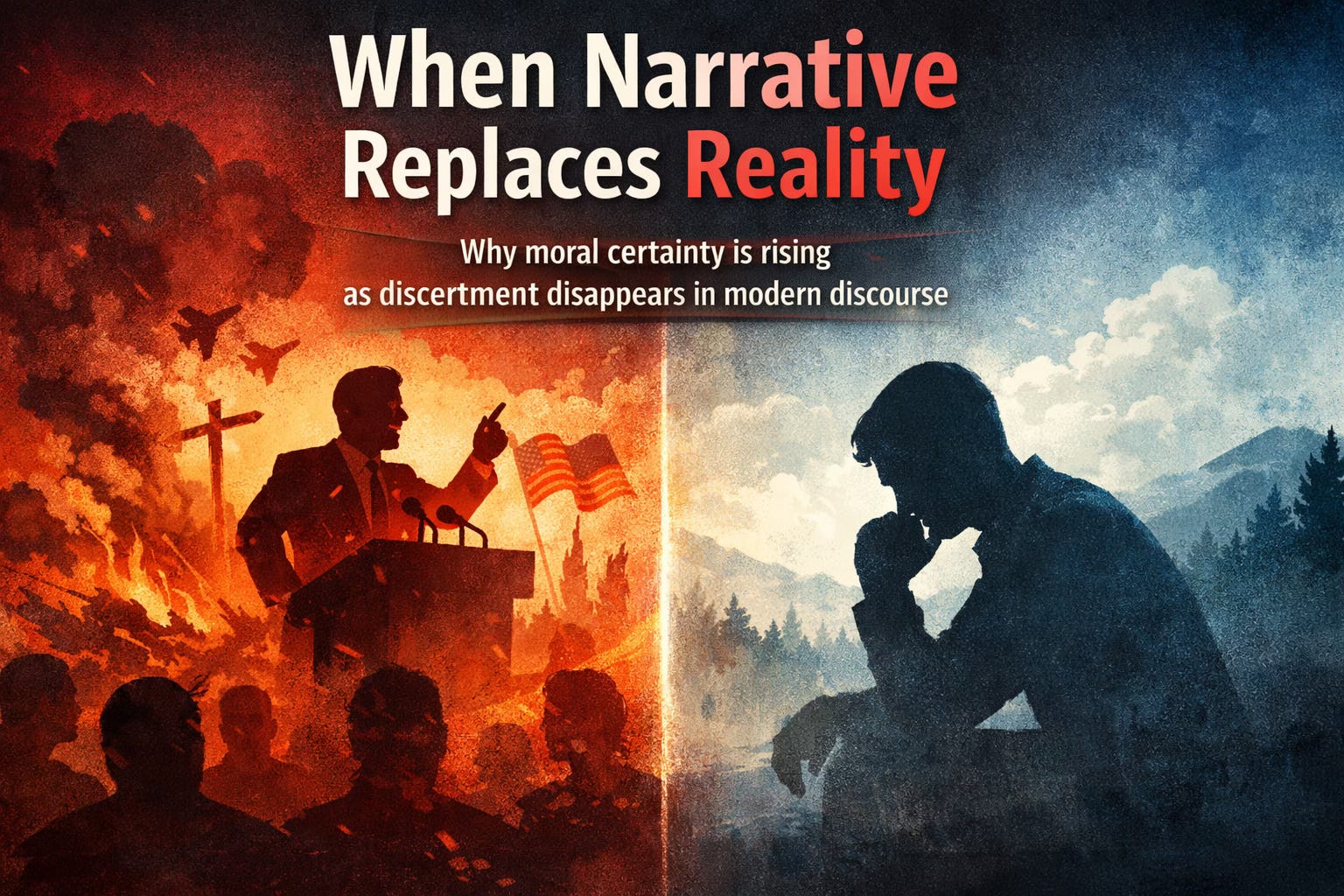
Narrative simplifies. It compresses complexity into something emotionally coherent and easy to process. It takes fragments of truth and arranges them into a story that feels complete, even when key distinctions are missing. In doing so, it replaces the slow work of discernment with the immediacy of reaction.
Discernment operates differently. It separates what is said from what is done. It distinguishes rhetoric from reality, possibility from probability, and intent from outcome. It resists the urge to collapse these categories, because once they are collapsed, analysis becomes assumption.
One of the clearest signs that discernment is being replaced is the disappearance of proportion. Claims expand beyond the evidence that supports them. Language escalates faster than verification. Emotional intensity begins to substitute for factual grounding. The argument may feel stronger, but its foundation becomes weaker.
Another signal is moral compression. Complex systems, whether political, social, or theological, are reduced to binary categories. One side becomes aligned with truth and virtue, the other with falsehood and harm. This framing is powerful because it removes ambiguity, but it does so by removing reality. The world is not divided cleanly along those lines, and when we pretend that it is, we stop seeing what actually exists.
Emotion plays a central role in sustaining this shift. The more intense the language, the harder it becomes to question the conclusion without feeling like you are betraying something important. This creates a subtle form of pressure, where disagreement is not treated as analysis but as moral failure. Over time, this narrows the space for honest inquiry.
Discernment resists that pressure. It insists that truth is not determined by how strongly something is felt, but by how well it is supported. It asks whether the conclusion follows from the evidence, or whether the evidence has been arranged to support a predetermined conclusion. It looks for what is missing, not just what is present.
This does not mean disengaging from serious issues or ignoring real harm. It means refusing to let urgency replace accuracy. It means holding complexity long enough for it to be understood, rather than rushing to simplify it into something more comfortable.
Because once narrative replaces reality, everything becomes easier to believe and harder to verify. And in that environment, conviction rises while clarity declines.
Discernment is what restores that balance. It slows the process down. It reintroduces proportion. It reopens the space between claim and conclusion. And in doing so, it allows truth to emerge without being forced into a story.