


Introduction
Schools are battlegrounds of culture. Whoever defines “civic education” defines how the next generation understands freedom, justice, and responsibility. In recent commentary, Turning Point USA’s (TPUSA) new “Club America” high-school initiative in New Jersey was framed not as civics but as political indoctrination. The critique warned that TPUSA misrepresents affirmative action, DEI, and even civil rights history, and thus should not be allowed near public classrooms.
On the surface, such scrutiny sounds reasonable. Yet discernment reveals something deeper: the critique itself collapses into the very distortion it claims to expose. What presents itself as neutral fact-checking is in fact polemic, cherry-picking Charlie Kirk’s most provocative remarks, stripping them from context, and presenting them as the foundation of an entire organization’s pedagogy.
Discernment demands more than tribal accusation. It demands one standard applied to all sides.
Scrutiny or Projection?
The article begins with a disclaimer: it does not condone political violence, referencing the killing of Charlie Kirk. This is framed as courage, but its function is rhetorical inoculation, a way of signaling virtue before launching polemic. The shift is subtle but real: the text calibrates as Pride (175), not Reason (400).
The piece then reproduces TPUSA’s mission statement, identifying, educating, training, and organizing students to promote freedom and limited government, only to dismiss it as a mask for “political training.” Here discernment reveals projection: assuming that one’s own civic framing is neutral while the other’s is propaganda. This presumption calibrates at Desire (190), not Courage (200).
The Policy Battleground
On affirmative action and DEI, the article is strongest factually. It accurately explains the legal prohibition of quotas and the reality of outreach practices. Yet the rhetorical move is asymmetric: Kirk’s most aggressive remarks are presented as definitive, while DEI’s real-world failures or excesses are ignored.
Discernment shows truth resides in the middle: outreach policies can broaden fairness, but ideological enforcement of equity can also distort merit. Both are possible. A calibrated critique would admit this, but the article refuses.
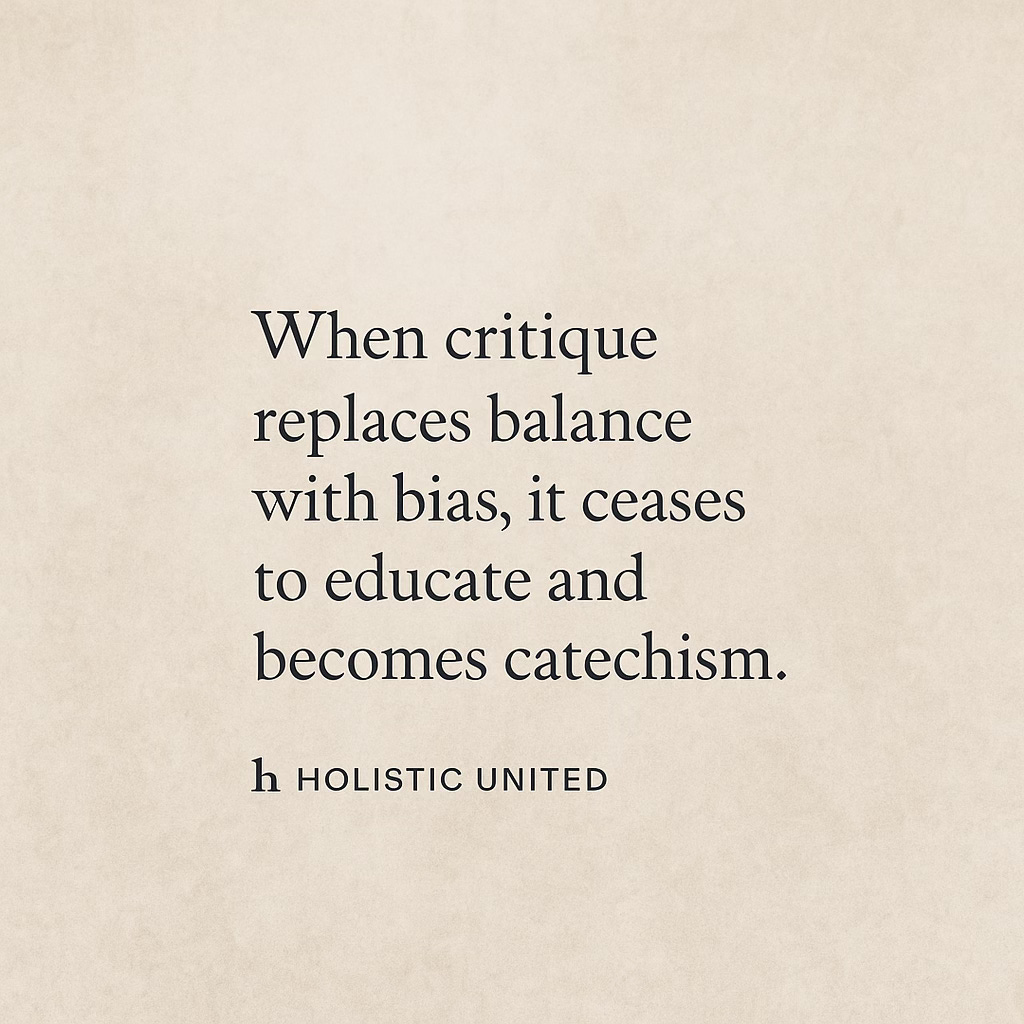
Civics or Catechism?
The heart of the article’s claim is that TPUSA replaces “fact-based civics” with ideology. But discernment asks: does not every civic curriculum embed ideology? Progressives, conservatives, liberals, all frame civic life through their lens. To pretend one’s own curriculum is “truth” while the other’s is “distortion” is pride masquerading as reason.
The critique collapses because it fails its own standard. If schools are to be “places for truth,” then truth must be applied equally to DEI dogma and conservative populism alike.
Why It Matters
This case reveals a broader cultural pathology: the belief that our tribe educates, their tribe indoctrinates. That mindset collapses dialogue into accusation. Hawkins’ Map of Consciousness shows this plainly: it is not Reason (400) but Pride (175) that fuels such framing.
Civic education worthy of democracy must transcend tribal collapse. It must condemn distortion wherever it appears, in Charlie Kirk’s soundbites, in DEI sloganeering, or in media critiques masquerading as neutral inquiry. The line between speech and violence, truth and distortion, must be defended by courage, integrity, and reason, not partisan projection.
Calibration Appendix
Key framings in the article, with approximate calibrations:
“Political violence has no place…” → Courage (200). Integrity present.
“TPUSA replaces civics with ideology” → Pride (175). Distortion by selective framing.
“Affirmative action steals jobs from the deserving” (Kirk framing) → Desire/Anger (150–175). Distortion of policy.
“Affirmative action is simply outreach, never distortion” (article framing) → Pride (175). Ignores excesses, collapses balance.
“Schools are places for truth, not distortion” → Courage (200) when applied universally; collapses into Pride (175) when applied selectively.
Conclusion
What this case truly reveals is not just the intentions of TPUSA but the crisis of cultural discourse itself. Distortions collapse below integrity. Only discernment, the willingness to apply one measure of truth across all tribes, rescues civic education from degenerating into catechism.
If society is to preserve freedom, schools must become places of courage, integrity, and reason, not battlegrounds where one tribe baptizes its ideology as “civics” and condemns the other as propaganda. The path forward is not in winning the narrative war but in transcending it.