


We trust people who have seen a lot. A clinician with decades of practice says something is far more common than the official figures admit, and it lands with weight. They have sat with thousands of people. We have not. Surely what they have seen counts.
It counts. It just doesn’t count as a number.
Experience can tell us something is there. It cannot tell us how often it is there.
A recent public exchange made this concrete. Someone with long clinical experience proposed that roughly half of all adults are neurodivergent. Asked for the basis, they pointed to years of practice, and to the fact that the concept hasn’t been validated well enough for population studies. The exchange was civil, and the claim was openly offered for disagreement. Whether you agree with the estimate is beside the point. What matters is the move it made.
Start with what is real. Clinical experience is knowledge. Many important discoveries began with someone noticing what no category described. One of the classic early descriptions of autism rested on eleven children. Close clinical attention can be how a field first learns that a group of people is being missed. That is what experience does well. It notices. It raises the question.
But a clinic is not a population. The people who come through the door arrived for a reason. They were referred, or they already suspected something, or they sought out a practitioner known for this work. A high rate inside that room is a fact about the room. Without a count of everyone who never walked in, there is no denominator. Without a denominator, there is no rate.
Researchers who sample whole populations, rather than clinics, report something different. Adult ADHD lands at roughly three to seven percent, depending on the definition. Adult autism lands at around one to two percent. Even the familiar figure of fifteen to twenty percent for all neurodivergent people together is a reasoned estimate from a review, not the result of a survey. None of these numbers is perfect. Some groups are almost certainly undercounted. But undercounting points to a higher number than the official one, not to any particular number.
Then comes the more interesting point. If the concept can’t yet be measured across a population, doesn’t that leave the number open?
That cuts the other way
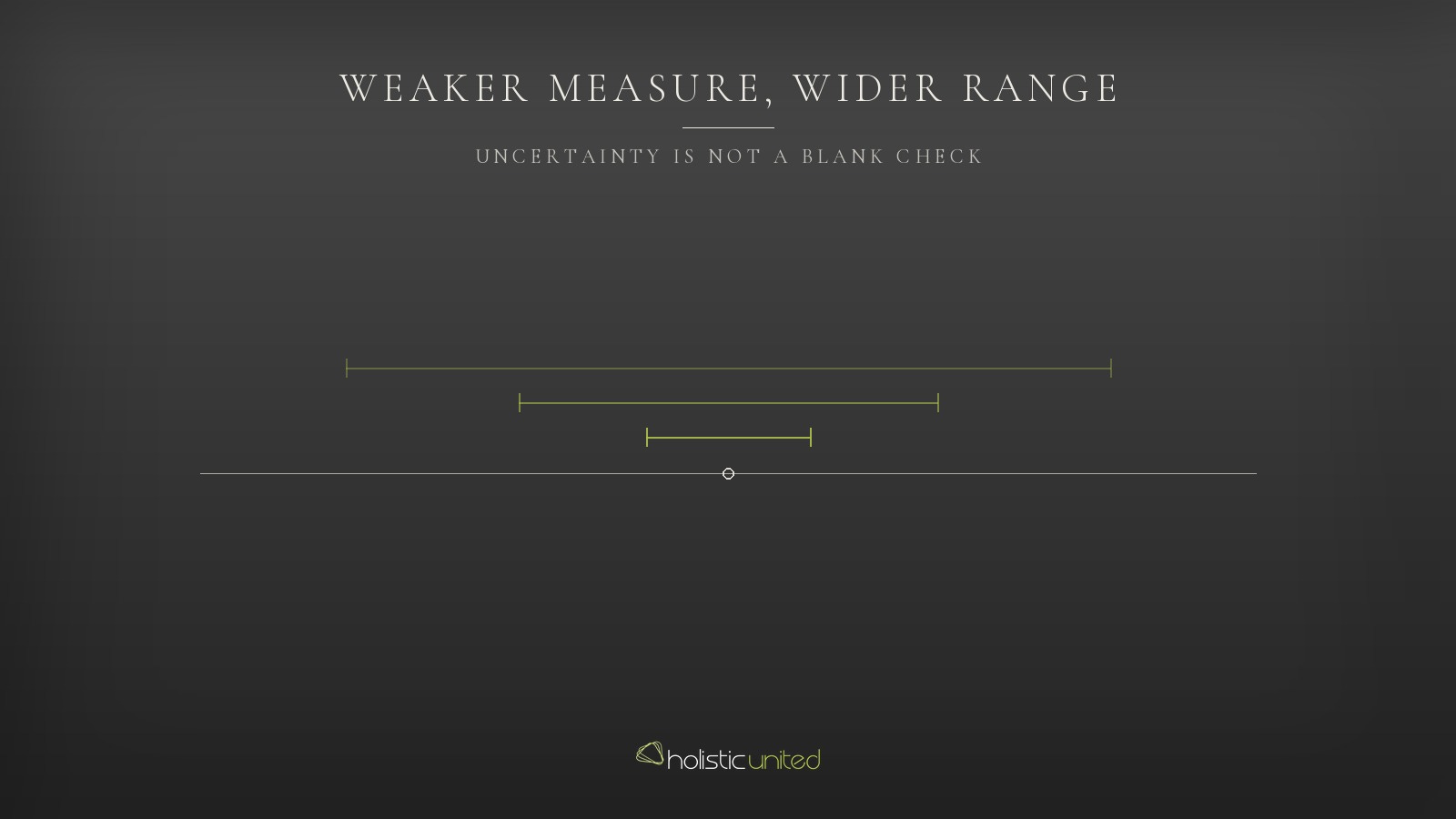
If we can’t measure it yet, we can’t be sure of the number. Any number. A concept without a reliable measure doesn’t leave the field open for whichever figure feels right. It widens the range of what might be true and lowers the confidence any single figure deserves.
Uncertainty is not a blank check.
There are two ways to get this wrong. One takes experience as proof and lets a confident estimate stand in for a count. The other dismisses experience as noise and waves away what clinicians, and neurodivergent people themselves, have seen for years. The first loses accuracy. The second loses information. Both make the same mistake: they let the source of a claim decide what kind of claim it is.
Two things often travel with confident numbers. A professional reputation staked on the claim, and the hope that if enough people speak out, the field will change. Fields do sometimes change because people speak out, and sometimes rightly. They change well when the speaking brings evidence the field had ignored. A reputation tells us how strongly someone believes. Volume tells us how many agree. Neither tells us how many people are neurodivergent.
None of this questions whether neurodivergence is real, or whether anyone’s experience of it is true. How common something is and whether it deserves recognition are separate questions. The second doesn’t wait on the first.
Discernment here is simple to say and hard to practice. It lets experience ask the question and lets populations answer it. When the measure is weak, it holds the number loosely instead of holding it tighter.
Experience notices. Counting measures.
Both matter. Only one of them is a number.