


We are living through a season of rejuvenation headlines. Old cells reset to a younger state. Aged mice that see again. A first-in-human trial with early signals. The word that keeps returning is reverse, as if age were a dial and someone had finally found which way it turns.
That isn’t a finding yet. It’s a vocabulary.
The trouble is not that the research is empty. Some of it is careful, published and genuinely surprising. The trouble is that one word, rejuvenation, is being asked to carry four different claims at once, and much of the excitement comes from letting them blur.
Start with what is real, because a good deal of it is.
In a 2022 study, researchers briefly switched on a set of reprogramming genes in skin cells taken from middle-aged donors, then switched them off again. On a transcriptome clock the researchers built, gene activity in those cells scored around thirty years younger, and the cells made collagen at youthful levels. In 2020, a team reported in Nature that three of the same genes, delivered into the eyes of mice, reversed vision loss in a model of glaucoma and in older animals. Other groups have reported changes in kidney, skin and memory in aged mice.
And in October, a company running a first-in-human trial of a related gene therapy announced that three people with glaucoma had tolerated a single injection through their first eight weeks, with no serious adverse events reported, and that two of them showed what it called preliminary signals of improvement on a standard test of their field of vision.
None of that should be waved away. None of it is the same thing as making a person younger.
Here is the distinction that gets lost.
A marker is not an outcome. An outcome is not a longer life.
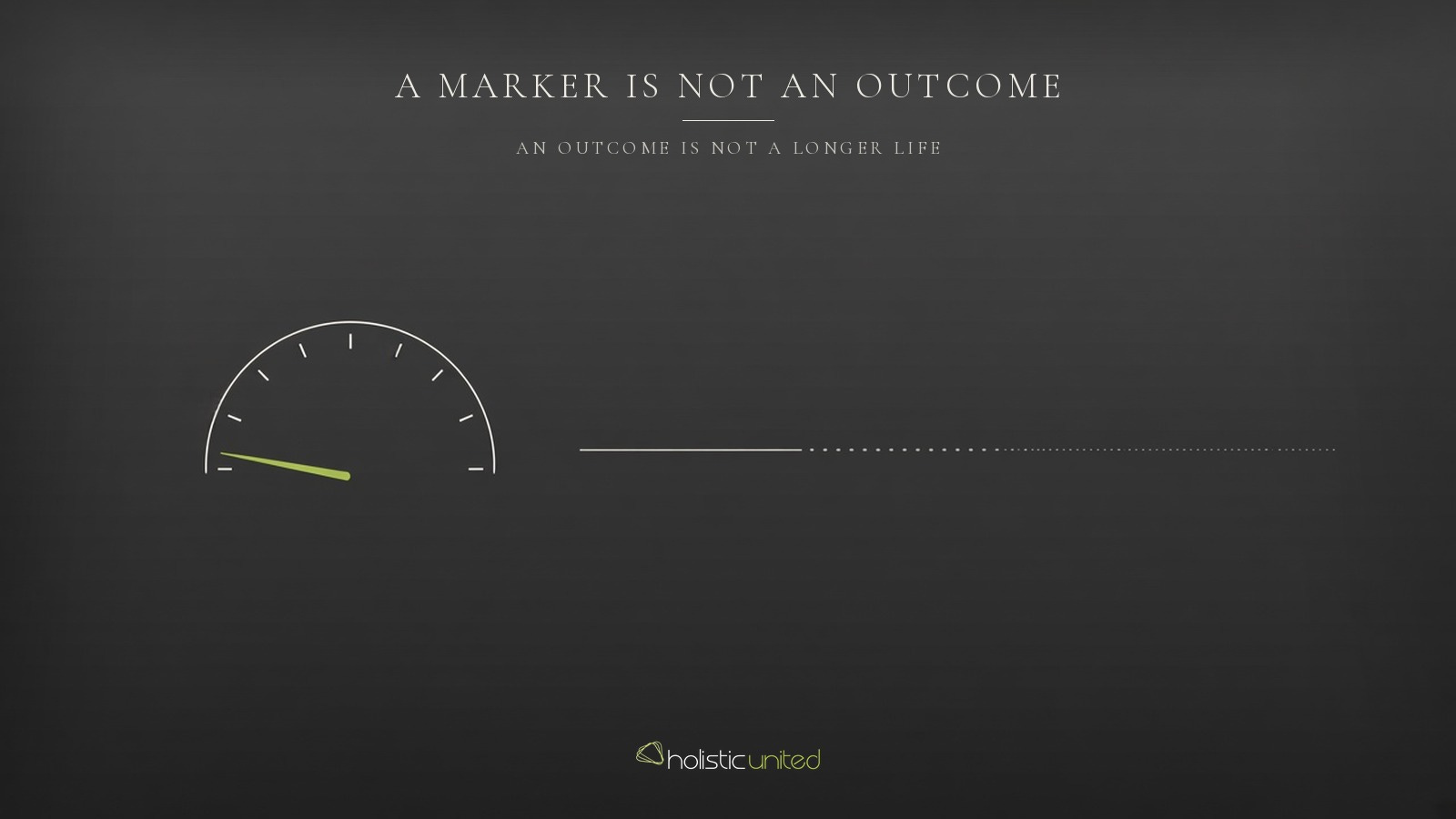
There are at least four different things a rejuvenation claim can mean. The first is a biomarker: a measurement that changes with age, such as the chemical tags on DNA that epigenetic clocks read. The second is function: does the tissue work better? Does the eye see, does the kidney filter? The third is healthspan: does the whole animal or person stay well for longer, with less frailty and later disease? The fourth is lifespan: does life last longer?
Each is a separate question. Evidence at one level does not climb to the next on its own.
A clock that reads younger tells you that a pattern the clock was built to track has shifted. Whether that shift means a healthier body, or a longer life, is a further claim that has to be tested directly. You can change a reading without changing what the reading was meant to stand for. The scientists who build these tools say as much. A large group of researchers writing in Cell in 2023 described a lack of standards and consensus on what makes an aging biomarker reliable, and said this holds back the work of validating such markers for clinical use.
The second distinction is about who has checked a claim.
A company announcement, a peer-reviewed paper, and a result repeated by an independent laboratory are not three ways of saying the same thing. They are three different stages of trust.
Take the human trial, because it is the case most likely to be misread. The October results came from the company’s own announcement. They describe three participants, in a study where everyone knew who was being treated and there was no comparison group. The trial’s public registration states that its purpose is to evaluate safety and tolerability. The company itself called the vision findings “preliminary signals of improvement.” Participants also took a tapering course of steroid medication to limit inflammation, and the announcement does not say how the vision changes compare with the ordinary variation from one test to the next.
None of this means the company is wrong. It means an announcement is where a claim begins, not where it is settled.
It is also a glaucoma trial. Even if every early signal holds, success would mean a treatment for damaged nerve cells in one treated eye. That would matter enormously to people who are losing their sight. It would not show that a human being has been made younger.
Independence matters for a related reason. Much of the most striking animal work comes from a connected set of laboratories and companies, and the researchers disclose those links, as they should. A connection is not a flaw in the data. It is the reason independent replication carries so much weight. So far, the direct repetitions that would settle the central claims were not found in the searches behind this piece, though some separate laboratories have reported related results in other tissues. One of the field’s central theories also faces a published challenge, titled “The information theory of aging has not been tested.” The authors have replied. The question is open.
Then there is lifespan, where the headlines run furthest ahead. The most striking mouse result began treatment in very old male mice and reported that their median remaining lifespan roughly doubled. That is remarkable. It is also narrower than “extends life”: it measured the last weeks of life from a very late start, in one sex, and its authors noted that an additional control would ideally have been included. An earlier lifespan result came from mice with a premature-aging condition. There are no human lifespan data at all.
And there is safety. In a 2013 study, switching on the original four reprogramming genes in mice pushed some cells all the way back toward an embryo-like state, and tumours grew in several organs. Newer protocols are designed to avoid that, and the newer animal studies we checked report no tumours or no adverse effects in the settings they tested. A different, chemical approach to reprogramming caused serious toxicity at higher doses in mice. Long-term safety in humans has not been established.
Both camps in this argument are protecting something true.
Those who are excited are right that aging may be more changeable than we assumed, that real results exist, and that people with untreatable conditions deserve research that moves. Those who are skeptical are right that a field this commercially charged needs a higher bar, and that early mouse findings are not advice for anyone’s life.
But each has its own shortcut. One treats a younger reading as a younger body. The other treats an early stage as a fraud. Both skip the same work.
The standard is simple, and it applies to everyone.
Say what was measured. Say in whom. Say who checked it. Say which level it reached.
That is what discernment does here. It does not decide in advance that rejuvenation is coming or that it is a fantasy. It keeps the marker apart from the outcome, the announcement apart from the evidence, and the hope apart from the proof.
Nothing here is medical advice, and nothing here recommends or discourages any treatment.
Rejuvenation may turn out to be real. If it is, it will be shown the slow way: in function, in health, in years, and in more than one laboratory. Until then, a younger reading is a reason to keep looking.
It is not yet the thing it measures.
The paid paper sets out the full yardstick, with the studies, their limits and the competing explanations.