


Something is badly wrong, and the room fills with certainty. The numbers are grim. The stories are worse. Someone names a fix, or a single path, and the severity of the problem is treated as the argument for that path. If you care, you already know what must be done.
That is not how evidence works.
A real problem does not prove the remedy.
A recent public exchange made the collapse visible without needing to put anyone on trial. A large social harm was treated as settling an exclusive choice about what must replace the present arrangement. Critics answered with labels: false dilemma, prove the only. The labels pointed at a real risk. They also risked becoming a way of never touching the evidence that had been offered. Whether you side with either voice is beside the point. The useful question is portable.
Is the claim that a problem is real, that a solution works, or that it is the only one?
Those are three burdens.
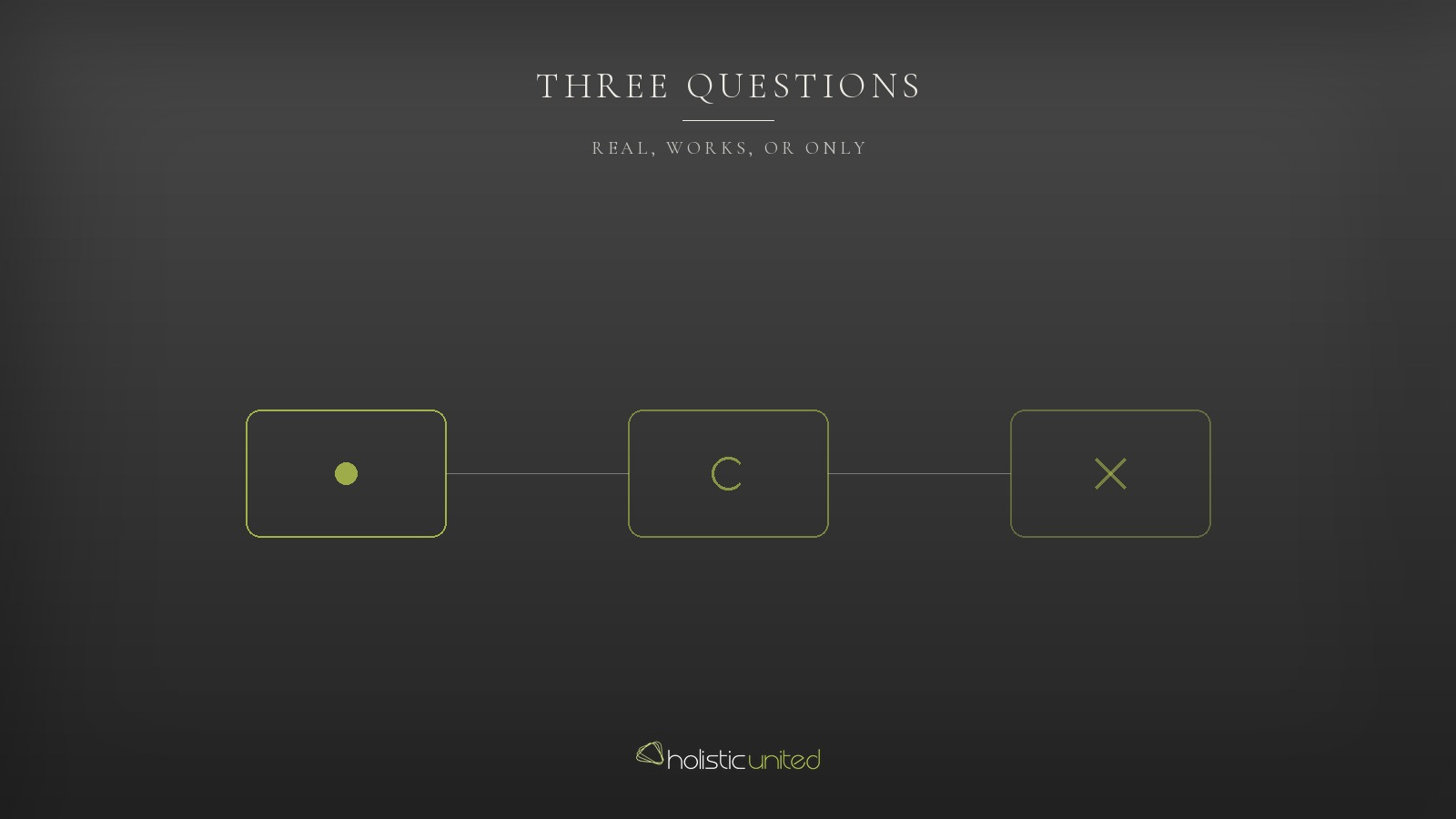
The first can be strong while the second is weak. Medicine learned this the hard way. A disease can be deadly and still leave a treatment unproven until someone compares outcomes. The harm answers one question. The trial answers another. Program evaluation makes the same cut: documenting need is not the same work as showing that a program changed results.
The third burden is stricter still. Showing that a fix helps does not show that nothing else could help, or that the choice is exclusive. Sometimes exclusivity is real. A bridge either holds the load or it does not. A protocol may leave no compatible alternative. Demanding an endless menu in those cases is a stall. But exclusivity has to be earned with constraints and falsifiers. Severity alone does not earn it.
Everyday life is full of quieter versions. Rising complaints become a full rewrite with no comparison to smaller fixes. Learning loss becomes one pedagogy as destiny. Burnout becomes a wellness vendor while staffing and workload go unexamined. In each case the problem may be genuine. The leap is still a leap.
There are two ways to get this wrong, and they wear different costumes.
One converts every crisis into proof of a preferred cure. The worse the news, the more the preferred path seems necessary. Need is laundered into uniqueness.
The other converts every exclusive claim into a fallacy on contact. It names the false dilemma and stops. It never says which alternatives are viable, never says what would count against the thesis, and never engages the evidence already on the table. The label becomes a substitute for work.
Both errors refuse the same standard.
Urgency does not erase the standard. When harm is accumulating, waiting is itself a choice. Acting under uncertainty can be responsible. Pretending the uncertainty has already resolved into a unique cure is not.
Grant the problem when the problem is real. Test the remedy as a remedy. If someone claims it is the only path, ask what makes the exclusivity true and what would show it false. Apply that to reformers and to defenders of the status quo alike. “There is no alternative” is a uniqueness claim whether it protects the present arrangement or a proposed replacement.
Discernment here is ordinary. It keeps the questions separate. It lets urgency speed the work without rewriting what the evidence has earned. It also refuses the cheap peace of saying both sides have a point and then changing nothing about the standard. The point is not neutrality. The point is matching each conclusion to the evidence that could actually support it.
A problem can be real.
A remedy can still be unproven.
An exclusive claim can still be wrong, or right, but it is never free.